Shoptalk Europe: Executive e-commerce insights & strategic takeaways

Estimated reading time: 5 minutes
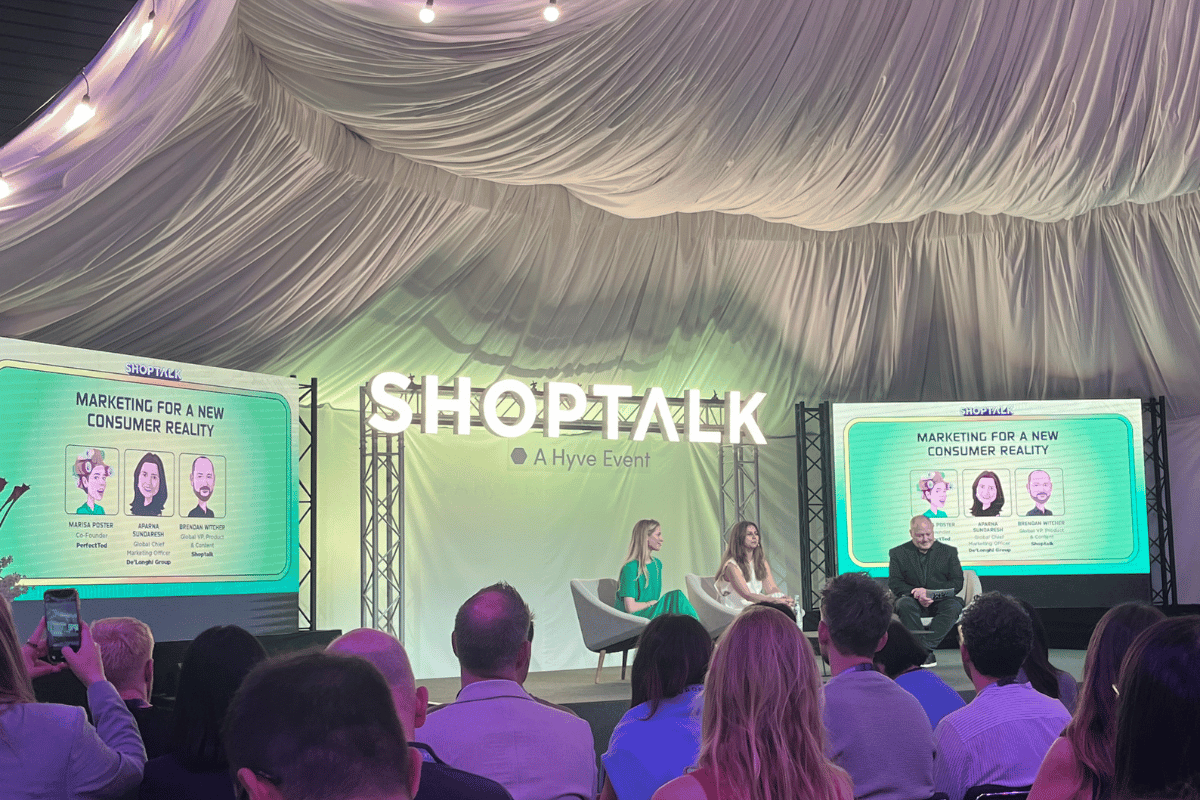
This June has been particularly intense and strategic for our teams! While part of the Verbolia crew was busy decoding the future of Search at the GEO Summit, our other experts headed to Barcelona from June 9th to 11th for the unmissable Shoptalk Europe.
As exhibitors, we spent three incredible days at our booth discussing your traffic acquisition challenges and our search solutions. But while part of the team was running back-to-back demos, other members slipped into the conference audience to catch the market’s strongest signals.
Here are the 5 defining trends that will shape e-commerce heading into 2026, straight from the stages of Barcelona.
For a long time, businesses viewed Artificial Intelligence purely through the lens of internal cost efficiency. In 2026, the narrative has completely flipped: AI is now a primary driver of the customer experience and direct conversion.
Take Vestiaire Collective, for instance. The luxury resale platform uses AI for photo analysis, brand/material recognition, price suggestions, and automated descriptions. This cuts listing creation time from six minutes down to just two. Across 30,000 daily submissions, this operational leap directly drives catalog volume and revenue.
Similarly, Zalando revealed that their AI assistant’s user base exploded to 10 million users. With 90% of their site content now AI-generated, they recorded a notable 13% increase in items added to shopping carts.
2. The rise of AI search and GEO (Generative Engine Optimization)
A striking statistic echoed through the aisles of Shoptalk: one-quarter of the population is already using AI to conduct searches.
Optimizing for traditional search engines is no longer enough. If Large Language Model (LLM) crawlers cannot organically discover, index, and read your site, your products simply do not exist to the AI-driven consumer.
This reality was front and center during discussions on AI-first discovery by Pentland Brands and Shopify, where leaders emphasized the urgency of “stocking the invisible shelf” for next-gen engines. Amish Mehta from Boots UK perfectly summarized the new mandate on stage:
“Ensure that LLM crawlers can explore your website!“
3. Breaking silos to adapt to “Moments of Life”
The traditional, rigid division between online and offline channels is dead. Consumers don’t think in terms of “channels”, they think in convenience, timing, and immediate needs.
The Spanish grocery giant, Alcampo, addressed this by completely abandoning legacy internal silos (like hypermarkets vs. convenience stores) to reorganize entirely around customer time. Whether a shopper wants a massive Saturday haul or needs a gallon of milk down the street in ten minutes, Alcampo’s unified ecosystem adapts dynamically to give them back their time.
4. Using automation to fund the human element
The biggest paradox of Shoptalk Europe was this: the more the industry discussed AI, the more it focused on being deeply human. Automation isn’t meant to replace the salesperson; it’s meant to scale their value.
The iconic UK retailer John Lewis is leveraging AI to aggressively lower its digital customer service OPEX. Why? To explicitly reinvest those savings back into high-touch, in-store human expertise, ensuring they can keep an expert salesperson available to consult a customer on bedding for an hour.
This sentiment was echoed by Andrew Lederman (VP of Global Digital Commerce at Mondelez), who reiterated a vital golden rule for the coming years:
“AI is here, we must adopt it, but the process must remain human.“
5. Hyper-agility and D2C ownership
To survive in 2026, brands must own their data and move at lightning speed, making legacy, monolithic tech stacks the ultimate bottleneck to growth.
The performance brand, Arc’teryx, attributed its spectacular growth over the last five years to a massive Direct-to-Consumer (D2C) transformation, allowing them to take full, uncompromised ownership of the customer relationship.
Meanwhile, Estée Lauder is operating under the mantra “Beauty Reimagined,” optimizing its entire P&L to rapidly reinvest wherever the consumer moves and radically shorten innovation cycles.
On the tech floor, this translated into an aggressive industry push toward Composable Architecture. Retailers are swapping rigid, single-vendor platforms for modular systems that allow them to test, iterate, and deploy changes in days rather than months.
The final word for Verbolia
The underlying takeaway from Shoptalk Europe is clear: your 2026 commercial strategy is only as good as your technical architecture.
You cannot capture AI search traffic, adapt to real-time customer moments, or scale D2C revenue if your business is held back by a rigid, slow-moving legacy stack.
To win tomorrow’s shoppers, and the LLM crawlers they use, your website must be agile, modular, and flawlessly crawlable.
Thanks to everyone who connected with us at our booth in Barcelona. The future of retail is definitely moving at lightning speed!
About The Author

How can Verbolia help your e-commerce platform.